
You can visit the Georgia page for detailed travel guides of Tbilisi, Batumi and other regions.
TRADITIONAL GEORGIAN FOOD
Georgian food is one of the world’s lesser-known cuisines, with flavors from Greece and the Mediterranean, as well as influences from Turkey and Iran. Georgian food is the most appropriate expression of Georgian culture. Hot, difficult-to-digest foods like khachapuri (cheese-filled pita) find balance with matsoni (yoghurt). Herbs such as tarragon, parsley, dill and coriander combine with walnuts and garlic to create delicious sauces.
Furnished tables, Georgian hospitality, tamada and supra connect families and friends. Tamada toasts everyone, the future, the present and the past, respectively; Sometimes there is joyful laughter, sometimes there are tears in your eyes. You will be surrounded by Georgian food and hospitality.

The most well-known dish among Georgian dishes is Khinkali. The beautifully twisted dough buns differ in shape and size from the ravioli (mantı) we are used to. Traditional khinkali is filled with meat and spices and served after boiling.

Thanks to its closure shape, it does not allow water to enter during boiling, it maintains its shape and remains in the broth. That’s why you need to eat it by hand, without spilling the broth, instead of using a fork and knife. Don’t underestimate it, it requires skill 🙂
Traditional khinkali is made with only meat and spices, but you can also come across ones filled with mushrooms, cheese and potatoes in restaurants.

BADRIJANI NIGVZIT AND PKHALI
Badrijani Nigvzit is created by adding walnut and garlic sauce and wrapping it between fried eggplant strips. Sometimes the fried eggplant strip can be folded in half and served with walnut and garlic sauce. The important thing here is the taste of the eggplant 🙂

I call Pkhali raw vegetable dumplings. Purple cabbage, leek, grated carrot and radish, walnuts and garlic are sometimes mixed with curd and shaped into oval or round shapes, pomegranate seeds are added on top and served cold.
LOBIO (BEANS IN POT)
Georgian interpretation of beans… Their taste and consistency are different. Beans cooked in a deep pot with plenty of coriander are served with Mchadi (cornbread) and pickles.

KABABI (KEBAP)
Kebab is not only Georgian food, it is a common taste of many regions. Kebab cooked on the grill is wrapped in lavash with sumac and onion slices and served as a wrap. The size of the wraps varies from place to place.

CHAKAPULI
Lamb stew with herbs from the Kakheti region is usually cooked on special occasions such as Easter.
It is cooked with beef or lamb meat, adding onion, tarragon, tkemali (sour plum sauce), white wine, garlic and of course coriander. It is served hot.

MTSVADI (SHASLIK – SHISH KEBAP)
It looks like a shish kebab. It is traditionally known by other names in the Caucasus and Central Asia. Since it became popular as Shashlik in the Russian Empire from the 19th century, it is now known as Sashlik in many places.
As it turns out, the tenderloin part is the most delicious part, as in our case, and there is one piece per person. Don’t swallow them all without realizing it 🙂 Since the meat is prepared mixed, if you do not consume pork, you need to say so.

SATSIVI

A winter dish that is usually served with roasted or boiled chicken and turkey and dipped in a sauce prepared with crushed walnuts, garlic, coriander and vinegar. Tsivi means cold in Georgian. As you understand from its name, it is served cold.
There are also vegetarian versions of this dish made with eggplant and cauliflower. I ate the rabbit one at Shavi Lomi, it was delicious.
The dish, which is usually cooked on Christmas and New Year’s days, is popular in the Adjara region.
Satsivis of the Caucasus is filtered through Levantine cuisine and served in hummus in Syria and Lebanon. It is known as Circassian chicken in Turkiye and Aquz in Iranian cuisine.
GEORGIAN BAKERY
KHACHAPURI (PITA WITH CHEESE)
Khachapuri is the most popular among Georgian dishes. That’s why you can’t say you’ve visited Georgia without tasting khachapuri. Khachapuri, loved by locals as well as foreigners, is an indispensable part of holiday tables. National Khachapuri Day is celebrated in Georgia on February 27 🙂
Different versions of Khachapuri have spread to many countries and become a favorite dish in restaurants.
KHACHAPURI TYPES
Adjara Style Khachapuri (Adjarian Khachapuri)

Megrelian Style Khachapuri (Megrelian Khachapuri)

Imeruli Style Khachapuri (Imeruli Khachapuri)

Royal Khachapuri

In addition to the ones I shared above, there are also versions of khachapuri in Svaneti with spinach and leeks added.
TONIS PURI (GEORGIAN TANDOOR BREAD)
Georgian traditional bread. I love it too. It is incredibly delicious when cooked in a circular hearth oven and hot with its sourdough flavor. It is said that the most delicious Puri is cooked in Borjomi because of its natural spring water.

It is called tonis puri because it is cooked in ovens called tone or torne (which comes from the same root as tandoor). It’s a different pleasure to take it from the oven on the way home, tear off the end, and walk while eating it 🙂
LOBIANI (BEAN BREAD)
Lobiani is similar in type to khachapuri, except it is filled with bean paste instead of cheese. The word Lobiani comes from the Georgian word Lobio for beans. The most delicious one is Rechuli Lobiani, that is, the one with bacon and beans 🙂 This version is usually cooked at the Barbaroba feast on St. Barbara day.

CHISHTARI (CORN BREAD WITH CHEESE)
Cornbread stuffed with cheese. It is originally from the northern part of Georgia, Svaneti region. A healthy food that you can take with you while trekking 🙂

GEORGIAN CHEESES
In Georgia, whether a festive table or a regular family meal, is not complete without cheese. Even if there is no food, puri, sulguni, tomatoes, grapes and walnuts are a feast for them 🙂 And for me too 🙂
SULGUNI
A fresh/pickled cheese variety specific to the Samegrelo region of Georgia. I can say that it is the national cheese of Georgians. A sour and slightly salty taste; It has a perforated texture and an elastic consistency.

It is prepared by melting fresh cheese called Imeruli. The cheese, which releases itself after melting, is given a flat and round shape and cooled. It is kept in water with salt and milk added to ripen. This ensures that it lasts longer.
It is sold in markets in normal and smoked form. Among the popular cheeses such as Smoked Sulguni, Smoked Gruyere and Smoked Gouda. It is used in all Georgian dishes made with cheese.

TELINI
Telini is a string cheese made from cow or sheep milk in Eastern Georgia. Milk with a high fat content is used in making cheese.

IMERULI
Originating from the Imereti region, cheese is made from cow’s milk. It looks like curd cheese. It ripens quickly, within a day or two. The cheese is soft, salty and has a sour taste.
GUDA
A traditional cheese from the mountainous regions of Georgia. It is made by ripening the cheese made from sheep’s milk in sheep’s skin. It’s a kind of overalls 🙂 That’s why it has an oily, fragrant and slightly salty taste; It resembles imeruli in texture.

DAMBALKHACHO
Dambalkhacho, another mountain region cheese, is a type of curd made from skimmed yoghurt. The real process starts after this:) After being formed into lumps, it is dried on dzobani (a special grill hung over the middle fire). During this time, it is kept away from sunlight. Afterwards, the dried pellets are placed in clay pots for 2-3 months and allowed to mature.

SAUCES OF GEORGIAN CUISINE
Each dish is served with a different sauce. While some are very suitable for our taste, some are very foreign to us 🙂 You can order the sauces you like from the sauces section, which is usually on the last page of the menus.
TKEMALI SOS (SOUR PLUM SAUCE)
A sour sauce made from plum varieties. Sweet plums can also be added to reduce the sourness level. In addition to plums, garlic, mint, coriander, pepper and salt, which are indispensable in Georgian cuisine, are used.

Tkemali is usually served with fried or grilled meat, poultry and potato dishes. It is thought that consuming it during meals strengthens digestion and protects internal organs.
ADJIKA (PEPPER SOUCE)
It consists of a mixture of red pepper, garlic, coriander, dill, blue fenugreek (found only in mountain regions such as the Alps or the Caucasus), salt and walnuts. There is also a powdered spice halide called Svanuri Marili. It goes amazingly delicious with potatoes 🙂

SVANETI SALT
It is made from a mixture of salt, garlic powder, cayenne pepper, and various spices and herbs such as fenugreek and coriander. It goes well with grilled meat, fish and chicken.

AND DESSERTS
Dessert doesn’t have much of a place in Georgian cuisine. My favorite is Adjara style baklava 🙂
ADJARIAN BAKLAVA
Since Adjara is so close to Turkiye, I think, the dessert is coming from Turkiye. It has the same taste as Turkish walnut baklava, only much larger in size 🙂

PELAMUSHI (PEPEÇURA IN TURKISH)
Pelamushi is a type of pudding made by adding sugar and starch to grape juice boiled after harvesting in the autumn. It is also possible to come across this flavor in Rize and Artvin (Blacksea cities which are so close to Adjara).

Its unfrozen form is also used to make churchkhela.
CHURCHKHELA
The dessert, which is claimed to be of Georgian origin, contains walnuts and hazelnuts, and the outside is usually covered with the unfrozen pelamushi and dried. While sold on the roadsides; You can see it in the traditional Georgian products section of the markets.

POPULAR GEORGIAN DRINKS
Georgians are a nation that can tolerate alcohol. No Georgian would ever complain about lack of alcohol or endless toasts at the table 🙂
GEORGIAN WINES
Georgia is one of the oldest wine-producing regions in the world. The fertile valleys and protective slopes of Transcaucasia have been home to viticulture and wine production for at least 8000 years. The fact that Georgians have been producing wine for thousands of years and the role of wine in their economy has made wine a part of the Georgian identity. We can say that it is the most consumed drink with Georgian dishes.
The best-known Georgian wine regions include Kakheti, Imereti, Racha-Lechkhumi, Kvemo Svaneti, Adjara and Abkhazia. There are more than 500 grape varieties grown in Georgia and used in winemaking.

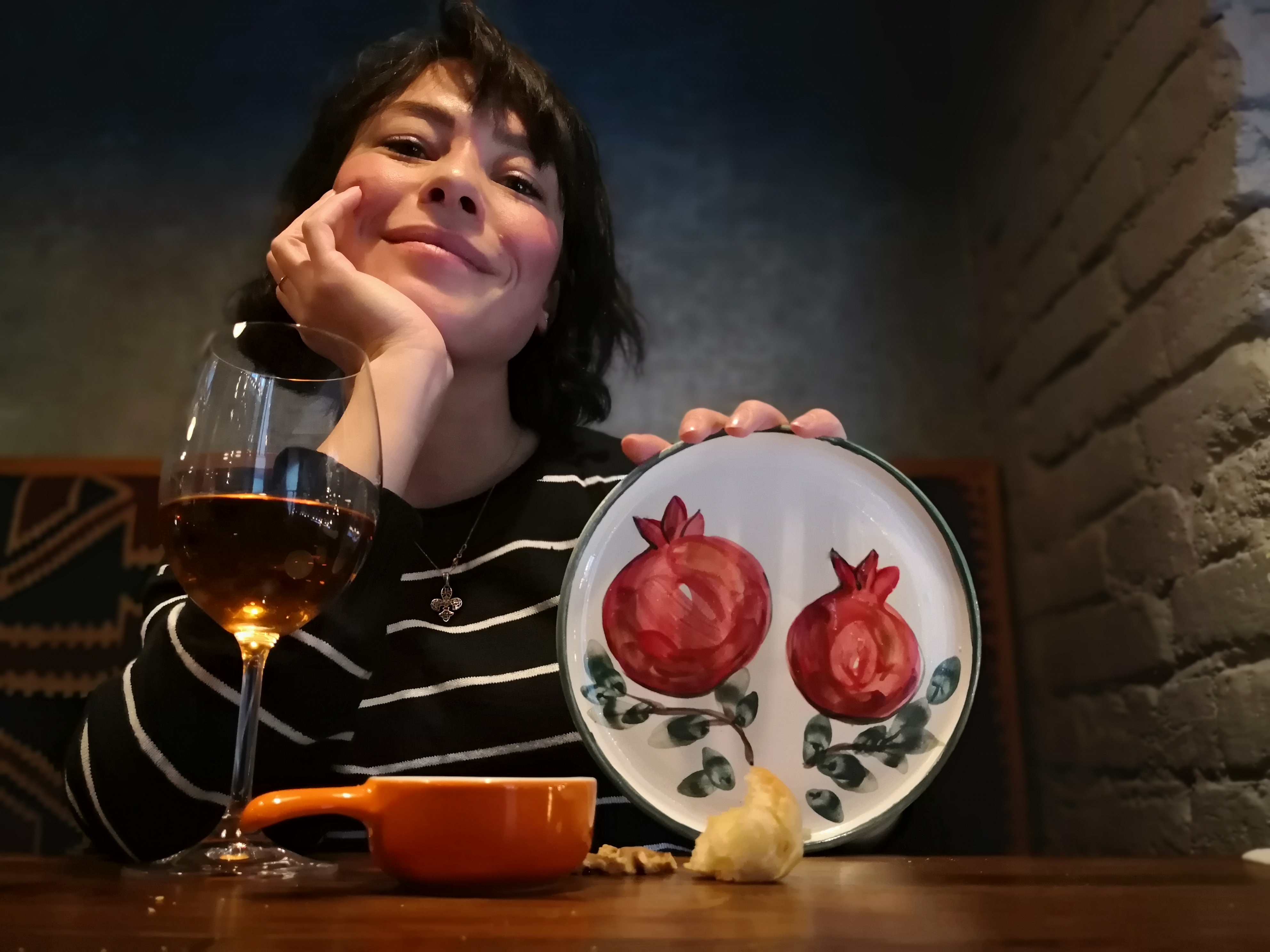
What I particularly want to talk about is Amber Wine 🙂 Qvevri, a pointed clay jug, is a clay pot used in traditional Georgian wine making. After the grapes are crushed and poured into the qvevri along with their fruit stalks and pulp for fermentation, the qvevri is buried in the ground. The natural warmth of the soil works its magic and amber colored wines emerge.

In 2013, UNESCO added the traditional Georgian winemaking method using qvevri to the UNESCO Intangible Cultural Heritage Lists:)
Other wines I tried and liked:
- White sec: Tbilvino – Tsinandali,
- White semisweet: Tbilvino – Tvishi, Marani – Tvishi
- Red sec: Chateau Khashmi – Kisi, Tbilvino – Saperavi, Marani – Saperavi
- Red semisweet: Tbilvino – Kindzmarauli, Marani – Khvanchkara
CHACHA
Pure and high-alcohol traditional Georgian brandy produced from grapes in Georgia. The alcohol content of commercially produced ones is 40%; The alcohol content of those distilled at home is 65% 💀
It is also called wine vodka because it is made from the grape pomace remaining after wine is made. Apart from grapes, figs, tarragon, tangerine and orange are also used in homemade ones.

Georgians believe chacha is a cure for a host of ailments, including ear congestion and indigestion. It is also said to cure acne when applied to the face. I am the liar of Georgians 🙂
BRANDY
It was first produced by distilling white grapes in the Cognac region of France and spread around the world. Since only those produced in Cognac are called cognac, the producers came up with a second name, brandy. It is also called brandy because it increases body temperature after drinking 🙂
Brandy (Cognac) production started in Georgia in 1830, but the main production foundations were laid between 1865-1873.
I love consuming Askaneli Brothers brandy by mixing it with hot coffee in cold weather. Delicious:)
Bonus: Before mercury, cognac was used in thermometers.
LAGIDZE WATER (LEMONADE)

Mitrophane Lagidze was born in 1896 in a small village of Kutaisi. He started working for a pharmacist at the age of 14, but he did not want to do this job for the rest of his life. He started researching soft drink production processes and decided to produce only natural fruits.
In 1887, he created a unique recipe for lemonade that is still a secret today, and became very popular in western Georgia in the 1900s. In order to be more successful in his job, Mitrophane went to Germany and France in 1902 to research new technologies.
He started importing glass bottles from France and created an inspiring label for his brand. On the label was a picture of his mother wearing a traditional Georgian headdress. The label says, “Request it everywhere. It has a unique taste and smell,” which attracts many customers. It was written. Sound familiar? 🙂
I’m a fan of the one with pear 🙂 I tried the one with tarragon but I didn’t like it.
BORJOMI MINERAL WATER
Georgia’s most famous water and mineral water brand. It floats from the peaks of the Bakuriani mountains and surfaces in the Borjomi valley. It is transported through pipes to two bottling plants in Borjomi.
The spring was discovered by the Russian Imperial army in the 1820s. The history of the brand is closely associated with the Romanov dynasty. With the Russian Revolution (1917), the Soviets took over Georgia and the Borjomi organization was nationalized.
Nowadays, Borjomi is exported to more than 40 countries. In 2012, Forbes valued the company at $500 million 🙂