
Batumi is like the summer house of Georgia 🙂 The city, which is quiet in winter, hosts many tourists from Russia, Azerbaijan and Iran in summer. It is not like the Black Sea, we know; people are unhurried and stress-free… Let’s dive deeper with Batumi Travel Guide 🙂

Batumi changed its shell very quickly after Georgia’s departure from the Soviet Bloc in 1991 and continues to do so. The state launched a major mobilization, especially to shake off the effects of communism and make Batumi a popular summer holiday destination as it once was. European-like squares, green areas and parks located within the city, and wide boulevards make this a pleasant place to live.
Here are the places to visit and see:)
GONIO CASTLE
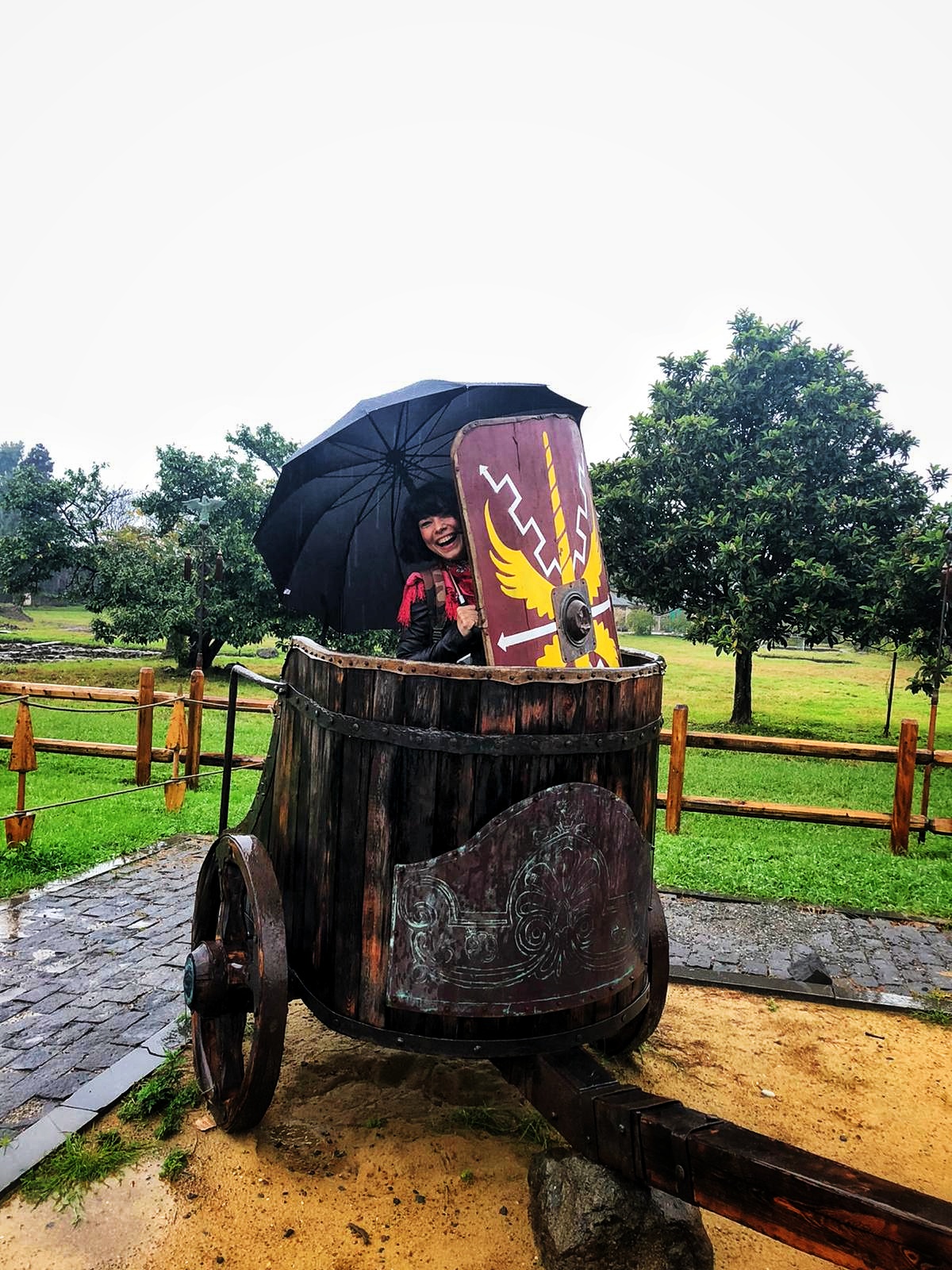
Gonio (Gonye) Castle is located between Batumi and Sarp, at the mouth of the Coruh Stream. The castle, built by Plinius Secundus in the 1st century, was rebuilt in the 2nd century. In the century, it turned into a small Roman town within the borders of Colchis. At that time, the town was known for its theater and hippodrome. The castle, which came under Byzantine rule after Rome, was taken over by the Ottomans in 1547. At that time, the castle was used as a market.

Afterwards, the castle fell into the hands of the Russian Empire, the Ottoman Empire, the British, the USSR and Georgia, respectively.
It is believed that the tomb of St. Matthias, one of the Twelve Apostles, is in the Gonio castle. For this reason, the Georgian government banned digging around the graves. However, archaeological excavations continue in the castle, especially focusing on the Roman period. The historical artifacts found are exhibited in the small museum inside the castle.


BATUMI BOULEVARD
The boulevard, which stretches for kilometers along the coastline, consists of large parks, statues and cafes. The public’s connection with the beach has not been cut off. A successful arrangement that includes both walking and cycling paths.


The length of the boulevard, which dates back to 1884 and was initially 1.5 km long, today exceeds 7 km. When it is completely completed, it is expected to extend from the city center to the airport and its total length will be 15 km.


Although the beach along the boulevard is stony, it is a little difficult to find a place to lay a towel in July-August 🙂 It is a great place to do your morning and evening sports and walk with your dog.

ALI AND NINO STATUE
Ali and Nino, Kurban Said’s masterpiece, was first published in Vienna in 1937 and was considered one of the romance novels of the century. This fascinating novel tells the story of two people who remain passionately committed to each other despite their different religions, cultures and wars.
Georgian sculptor Tamara Kvesitadze was inspired by the book Ali and Nino in her 8-meter-tall “Man and Woman” sculpture. The male figure in the statue represents a Muslim young man named Ali, and the female figure represents an Armenian Princess living in Georgia named Nino. The statue was unveiled in 2010.


In the story, East and West live side by side but opposite each other. Ali Khan Shirvanshir, who is a part of the East, and Nino Kipiani, who is a member of a family that takes Europe as an example, fall in love with each other during their school years. In order to experience this impossible love at that time, it was necessary to remove the border between East and West. After graduating from high school, Ali proposes marriage to Nino. Ali’s father supports the idea of marriage, but Nino’s father tries to postpone the marriage. Lovers who go through many troubles eventually get married, but the troubles do not leave them even after marriage. Just when they say they are happy, the Caucasus Federative Republic, consisting of Armenia, Azerbaijan and Georgia, goes to war with Soviet Russia. Ali goes to war to defend his country and dies there. If you are interested in the movie, you may find the details here.
BATUMI ALPHABET TOWER
The tower, which is one of the symbolic structures of the city of Batumi, is also the symbol of the 33-character Georgian alphabet and the symbol of the ancient Georgian people preserving their own identity while modernizing.

Inspired by the helical structure of DNA, Spanish architect Alberto Domingo Cabo placed the letters of the Georgian alphabet on the double spiral staircases of the 130-meter Alphabet Tower. With the elevator located in the middle of the building, the surrounding structures can also be seen. There is a restaurant and cafe in the crown of the building, with a huge silver ball at the top. You can also enjoy the city view while sipping your coffee 🙂
BATUMI LIGHTHOUSE AND FERRIS WHEEL
Batumi’s first lighthouse was built by the Ottoman Empire in 1863; The second one was built by the Russian Empire in 1872 but has not survived to the present day.
The 21-meter stone lighthouse in Miracle Park was built by French engineers in 1882 at the request of the Russian Empire.

You can enjoy the city for a long time with the Ferris wheel, which completes its rotation in exactly 15 minutes.


CHACHA TOWER
The structure, commonly known as the Chacha Tower, was designed by French architect Raymond Charles Pere. There is disagreement about the places where the design was inspired. One group says it is a replica of a building found in Batumi at the beginning of the 20th century; Another group argues that it was inspired by the Ottoman style.

The first tower was built on the seashore a century ago. It was renovated by the Georgian Government in 2012. The 25-meter clock tower is surrounded by four fountains, and in the past, chacha, a strong Georgian drink, flowed from these fountains for 15 minutes at 19:00 😉🍻
BATUMI PIAZZA
Batumi One of the must-see spots of your trip 🙂 The 5700-square-meter Batumi Square is designed in the Italian style and is surrounded by the Piazza complex, which includes a hotel, several restaurants, a cafe and a pub. The architecture is supported by mosaics and stained glass art.
La Brioche, located in the Piazza, hosts live music every day and also hosts concerts of world-famous musicians visiting Batumi.

Batumi Square is 4 blocks away from Batumi Boulevard and is among the most visited places in Batumi 🙂

Bonus: One of the unique beauties of the Piazza is the 106 square meter mosaic in the middle, designed by Georgian-Swiss writer and designer Natalia de Pita Amirejibi. Created according to the designer’s original drawings in his workshop in Abu Dhabi, the mosaic was assembled piece by piece in August 2010. The mosaic is made of 88,244,735 cut and finished elements, each 1 cm square. The marbles used for the mosaic were brought from 15 different countries. The sea goddesses in purple and red dresses are made of smalt and ceramics.

Mozaik, deniz yüzeyindeki girdapları anımsatan, birbirine kenetlenen 8 daireden oluşuyor. Her daire süs ve figüratif unsurlarla süslenmiştir; merkezi daire beş kadın figüründen oluşmaktadır. Kırmızı, açık mavi, mor, pembe ve yeşil renklerle süslenmiş bu figürlerde deniz tanrılarının dişi hipostazları (tanrı, tanrıça, prens) yer alıyor. Tanrıçaların giydiği renklerin kişiliklerini yansıttığına inanılmaktadır. Kompozisyonun ana figürü olan küçük sirenin (denizkızı) tasarımcının beş yaşındaki kızı Romina olduğu da biliniyor.
By the way, don’t forget to examine the clock tower in the square in detail:)

HOLY MOTHER VIRGIN NATIVITY CATHEDRAL
Actually, it would be more correct to call it the Cathedral of the Nativity of the Blessed Virgin. The church was built in 1897 with the financial support of the well-known brothers Zubalashvilebi in Georgia. The stage of the three-domed church is in gothic style, and its exterior appearance is neo-gothic.

During the Soviet Union regime, the church was used as an archive and a high-voltage laboratory. After Georgia regained its independence, it was opened for use as an Orthodox Church. It is claimed that the church was built with special stones and that it changes color depending on the weather (sunny, rainy, etc.). (I stop by every time I go, but I didn’t notice 🙂


The lights reflecting from the stained glass windows of the saints in the church windows are fascinating. There are no bell towers you can climb like churches in Europe.


You can take a breath under the trees in the large garden of the church and plan your next visit 🙂

EUROPE SQUARE
Europe Square (formerly known as Era Square) is one of the central places you will pass/see dozens of times during your stay in Batumi. The main meeting point for Batumoba (Batumi Day), Gandagana Folk Festival, Christmas Market or any city celebration 🙂

Its name comes from Batumi’s participation in the European Assembly of Regions. The statue of Medea is placed in the middle of the square as a historical symbol of Georgian connections with Europe. Concerts by Jose Carreras, Andrea Bocelli, Bueno Vistas Social Club and many more were held here. More than 50,000 people listened to the Enrique Iglesias concert in 2011. There is a useful bike rental point right next to the Medea statue 🙂
MEDEA SATUE
The Statue of Medea and the Golden Fleece rise into the sky in Batumi’s Europe Square. It was made by Georgian sculptor David Khmaladze.

The reason why the necklace around Medea’s neck and the crown on her head were made of gold is because of thousands of years of master gold processing of the Colchis Kingdom living in the region. The statue, which cost 1 Million GEL, was opened on June 6, 2007. Statue; It is located in the center of the square, which is the meeting point of the city with its fountain pool, children’s playground and green texture.
You can find the story of the Golden Fleece and Medea, an important person in Greek and Colchis mythology, here🙂
ASTRONOMICAL CLOCK
The Astronomical Clock was made in Germany in 2010 by the Batumi city council and cost 1,700,000 GEL. The clock set in the tower is similar to the clock in the Prague town hall. It adorns the restored facade of the former building of the National Bank of Georgia.


Equipped with special devices, the watch shows not only real-time but also astronomical information such as the position of the sun, the moon, the zodiac constellation and the planets. It also shows the meridian, horizon, sunrise and sunset based on the movement of the sun, the age of the moon and the actual movement of the moon on the earth.
In front of the clock, there is a special table that explains the purpose and rules of using the astronomical clock.
We have come to the end of the first day of Batumi Travel Guide 🙂 You can visit the Batumi Travel Guide Day 2 page to continue your Batumi trip.