
Zugdidi is a city located in the historical region of Megrelia, in western Georgia. It is also the administrative center of the Samegrelo-Zemo Svaneti region. It is located in the Odishi plain, on the banks of the Choushi river.

Railway and state highway pass through the city. The city also serves as the seat of the Metropolitan of Zugdidi and the Diocese of Tsaishi of the Georgian Apostolic Autocephalous Orthodox Church.

Bonus: Zugdidi celebrates the Vlakernoba folk holiday on July 15. On this day, Orthodox pilgrims from all over the world flock to Zugdidi. The relic is removed from the storage of Dadiani Palace and Museum of Architecture and brought to the Cathedral of the Blessed Virgin Mary of Iveria. Throughout the day, people walk with the sacred relic and pay their respects to it.
Zugdidi History
The use of the name Zugdidi is first encountered in sources in the 17th century. Zugdidi means big hill in Mingrelian.
Bonus: Eski kaynaklarda aynı anlama gelen “Zubdidi” kullanımına da rastlanmaktadır. Megrelya ve Abhazya’daki Megrel köylerinde ise bu ismin kısa formu olan “Zugidi” de görülmektedir. Şehrin doğusundaki tepe şehre bu adı vermiştir. Bu tepede antik dönemden kaleler yer almaktadır.


Zugdidi came under Ottoman rule between 1855 and 1857. It was the capital of the Principality of Mingrelia until its abolition by the Russian Empire (1867). Later, Zugdidi was an administrative center of Zugdidi Uyezd and part of the Democratic Republic of Georgia, as part of Kutais Governorate until 1918. From 1930 it became the center of the Zugdidi Raion of the Georgian Soviet Socialist Republic. After 1991, it was annexed to Independent Georgia.
Population of Zugdidi
Zugdidi has been known as a mono-ethnic city throughout history. 98.97% of its population consists of Georgians.
In the 1950s and 1970s Zugdidi developed and the population increased rapidly. The population increase in the last 20 years is the result of migration from other cities to Zugdidi. Especially during the Russian-Georgian War in Abkhazia, many ethnic Megrelians were forced to migrate to Zugdidi. This migration also triggered population growth.
Places to Visit in Zugdidi
Zugdidi is not a particular attraction to visit. People use Zugdidi as a stop for food and essentials on their way to Mestia. We stopped in Zugdidi to eat and do some shopping, but while we were at it, we took a quick city tour 🙂 Zugdidi has the biggest market in the area. If your accommodation is an apartment or a home-style place, you can find the freshest things to cook.

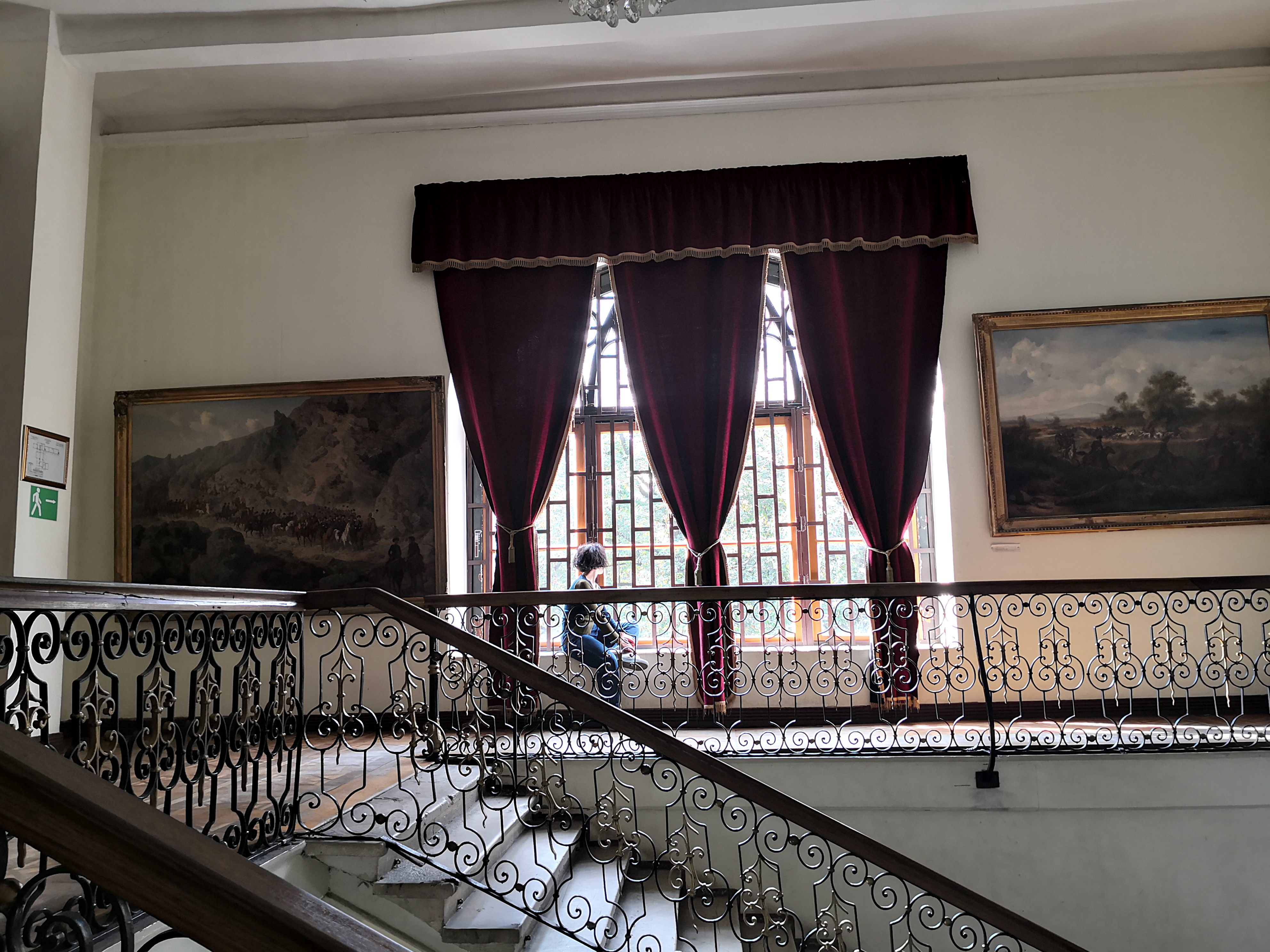
Dadiani Palace, Museum of History and Architecture
It is a museum complex that includes the Dadiani Palaces Historical and Architectural Museum, the Church of Our Lady of Blachernae and the Zugdidi Botanical Garden.
Built in the 19th century, Dadiani Palace was home to the last ruling family of the Principality of Samegrelo.
The complex, the palace of Ekaterine Dadiani of Samegrelo, also served as a residence and a monastery. Today, the palace operates as a museum and is open to visitors. The garden of the palace is the Zugdidi Botanical Garden. There is only one tree in the botanical garden, different from grass 🙂


The first exhibition consisting of the archaeological remains of the ancient city Nokalakevi was prepared by Megrelian Prince David Dadiani and was exhibited for the first time in 1840. Remains of the treasury in Tagiloni, Georgia, the sacred regalia of the mother god, the icon of queen Bordokhan, the icon of queen Tamar, manuscripts and miniatures from the 13th and 14th centuries, some of the belongings of French Emperor Napoleon Bonaparte, brought to the palace, are exhibited in the palace.
Bonus: Prince Achille Murat is the eldest son of Napoleon’s sister Carolina and Napoleon’s brother-in-law Joachim Murat, who was appointed King of Naples during the First French Empire. After his father was deposed and executed by his own subjects, Achille Murat was exiled to Austria with his brothers and mother.
Achille Murat (standing in uniform) with his mother, Princess Carolina, and his brothers and sisters.


The palace was completely turned into a museum on May 1, 1921, with the initiative of Georgian ethnographer and geologist Akaki Chanturia. Since taking photographs is prohibited inside the museum, I cannot share detailed photographs with you.


Are we hungry? Yes 🙂
I chose Diaroni for lunch. Both its decoration and taste received full marks. The fact that the walls were covered with brick and the lighting was warm yellow made me feel like we were in a wine cellar. Plates were filled with traditional Georgian dishes and glasses were filled with Saparevi.


I fastened our seatbelts and set off for Mestia. I feasted my eyes on the route between Zugdidi and Mestia. You are so beautiful World 🙂


See you in Mestia…