
Here we are, our 3rd day in Tbilisi 🙂 If you have enough time to visit Tbilisi, the Tbilisi Travel Guide I prepared can help you 🙂 If you haven’t read my articles on Tbilisi Travel Guide Day 1 and Tbilisi Travel Guide Day 2, here you go 🙂
FREEDOM SQUARE / TAVISUPLEBA

The most famous square in Tbilisi. Formerly known as Yerevan Square, during the Soviet Union period, it was known as “Beria Square” and later “Lenin Square,” respectively. With the establishment of the Georgian Republic, its name was changed to Freedom Square. In 2005, George Bush and Saakashvili met in this square during World War II. They addressed 100 thousand people in this square in their speech on the 60th anniversary of the end of World War II. There is a large monument with a statue of St. George in the square, which can be reached from many streets.
Bonus: The story of St. George’s fight with the Dragon, an iconic figure in the Christian world, actually came to Europe via the Middle East. George, a Roman soldier, lived in the region of the Roman Empire in today’s Turkey. He received the title of Saint after he was later exiled, tortured and killed. The story of St. George and the Dragon is actually the story of the Christianization of the Cappadocia region during George’s time.
Legend has it that there was a dragon in a rural city. The people of the city protect themselves from the dragon by sacrificing sheep every day. But when his sheep run out, it is time to sacrifice the people in the city to the dragon by drawing lots. When it is the king’s daughter’s turn, the king objects, but with the pressure of the people, the princess is offered to the dragon to be sacrificed. At that time, George, passing by, fights with the dragon, saves the princess, catches the dragon and brings it to the city. He tells the people that he will kill the dragon and save them if they accept Christianity, and that’s what happens.
In this allegorical story, the dragon represents Satan and impiety. That’s why George defeated the devil by killing the dragon. The princess symbolizes the “liberated” people of the region who accepted Christianity. A legend painted by many artists.


RUSTAVELLI STREET
Rustavelli Street starts at Freedom Square and stretches for 1.5 km. Tbilisi thanks to the government, public, cultural buildings and famous brands located on or near it (Old Georgian Parliament building, Georgian National Opera Theatre, Rustaveli State Academic Theatre, Georgian Academy of Sciences, Kashveti Church, Georgian Museum of Fine Arts, Georgian Simon Janashia Museum, etc.) It is considered the main street of Tbilisi.

It takes its name from the Georgian poet Shota Rustavelli, who lived during the reign of Queen Tamara. In order not to disrupt the traffic, it is planned to place too many traffic lights and pedestrian traffic will be carried out through underpasses. It is also the place with the busiest New Year’s decorations in Tbilisi 🙂
Bonus: On April 9, 1989, 10,000 Georgians gathered in front of the government building on Rustavelli Street for Georgia’s independence. Resistance included a hunger strike, but was peaceful.
The demands were sent to the Soviet Ministry of Internal Affairs by the First Secretary of the Georgian Communist Party. Thereupon, a unit under the command of Col. General Igor Radionov was sent. Hours before the intervention, the Georgian Orthodox Church begged the crowd to leave the area, but the resisters refused. Minutes before 04:00 in the morning on April 9, Radionov ordered his soldiers to clear the area using all roads. 21 people died and hundreds were injured in the fire opened by the union.
This event is known as the April 9 Tragedy, Tbilisi Massacre, or Tbilisi Tragedy. April 9 is currently celebrated as National Unity Day in Tbilisi.
TBILISI IMPERIAL THEATER
Founded in 1851, the Tbilisi Opera is Georgia’s main opera house and one of the oldest organizations in Eastern Europe. The theater has been in service since 1896, in a building designed in the exotic neo-Moorish style by Baltic-German architect Victor Johann Gottlieb Schröter.

Although oriental in its decorations and style, the layout of the building, its foyer, and its main hall resemble a typical European opera house. Since its founding, the theater has been damaged by several fires. Major renovation works were carried out under the Soviet and Georgian administrations. The latest restoration work was financed by the Georgian Business Foundation (costing 40 million USD) and completed in January 2016, lasting 6 years.
If you want to go to an opera or ballet performance while you’re here, You can find the event calendar here and buy your tickets here 🙂
I watched Sleeping Beauty. It was very successful; I recommend it 🙂 You are also expected to be a little stylish when it comes to clothing because there is a dress code.


KASHVETI CHURCH
It was built between 1904 and 1910 by architect Leopold Bilfeldt with a design based on the medieval Samtavisi Cathedral. Georgian nobles and bourgeoisie financed the construction. It was built of stone at the request of the Amilakhvari family to replace a damaged church. The frescoes of Kashveti were painted by the famous Georgian artist Lado Gudiashvili in 1947. It took its name from the legend of Mama Daviti.


SHALVA AMIRANASHVILI MUSEUM of FINE ARTS
It is one of the 13 museums under the umbrella of the Georgian National Museum. Approximately 140,000 Georgian, Oriental, Russian, and other European works of art are on display.


Bonus: Tamada is the great person (toastmaster) who speaks during toasts at Georgian tables and ensures that traditional rules are followed at the table. It is chosen among people who are intellectual, have the ability to speak eloquently, can tolerate wine, and have authority. The host or the person giving the food either becomes the tamada or chooses the tamada and then follows the rules set by him.
In the oil painting I am sitting in front of, the mustachioed and statue at the head of the table symbolize tamada. The table is sacred for Georgians. That’s why they are provided with the most delicious meals and do not get up immediately, but talk for a long time. Tamada toasts everyone—the future, the present, and the past, respectively.
MTATSMINDA PANTHEON
Kilise, 6. yy’da Gürcistan’da Hristiyanlığın yayılmasına yardım eden ve bugün kilisenin bulunduğu arazide küçük bir mağarada yaşayan Suriyeli bir papaz olan St. Davit Gareji’nin adı verilmiştir. Mama Daviti Kilisesi’nin bahçesindeki anıt mezarlıkta Gürcü tarihinin en önemli yazar, sanatçı, milli kahramanlarının mezarları bulunuyor. Burada ebedi istirahatte olanlara buradan erişebilirsiniz:)
The church was built by St. Paul, a Syrian priest who helped spread Christianity in Georgia in the 6th century and lived in a small cave on the land where the church stands today. It was named after Davit Gareji. The monumental cemetery in the garden of Mama Daviti Church contains the graves of the most important writers, artists and national heroes of Georgian history. You can access those who are at eternal rest here 🙂


Bonus: According to legend, at that time, Tbilisi was under the control of many different dominant religions. That’s why no one paid attention to Mama Daviti’s prayers for Jesus Christ, and she was accused of impregnating a woman. In response, Mama Daviti created a miracle and made the baby in the woman’s womb say its father’s name. Afterwards, the woman gave birth to stones instead of a baby. That’s why the place where the church is located is known as the place where the legend took place, and it is called “Kashveti” (Georgian kva means “stone” and shva means “to give birth”).”Giving Stone”. This white church is different from all other churches in appearance; it was built only with white stones.
Of course, the legend does not end there, in the second act, Father David felt sorry for the disappointed woman and prayed for her. Shortly after, a natural spring appeared where he lived. People call this source “Tears of David”. Many people come to visit the church and drink this water in the belief that they will heal or become healthier 🙂
A quiet and beautiful place to watch Tbilisi from above 🙂
MTATSIMINDA PARK
Located at the top of Mtatsminda Mountain, overlooking the wonderful view of Tbilisi, the park has carousels, water slides, roller-coasters, funiculars, and a large Ferris wheel that offers a magnificent view at the edge of the city, which those who know it love very much. You can also take a look at the shops selling souvenirs while going to the park 🙂

FLEA MARKET

Dry Bridge is an excellent flea market in the center of Tbilisi for those who love old and antique things. Antiques, jewelry, old books, maps, pins, and badges—some local, some Soviet, and some from abroad—are offered for sale. The name of the market comes from the bridge over the river. The Flea Market opens daily from 10:00 to 17:00, if the weather is nice. Weekends are more colorful as there are more sellers and more tourists 🙂 Prices are negotiable, but it is worth paying attention to high prices, especially for tourists 🙂
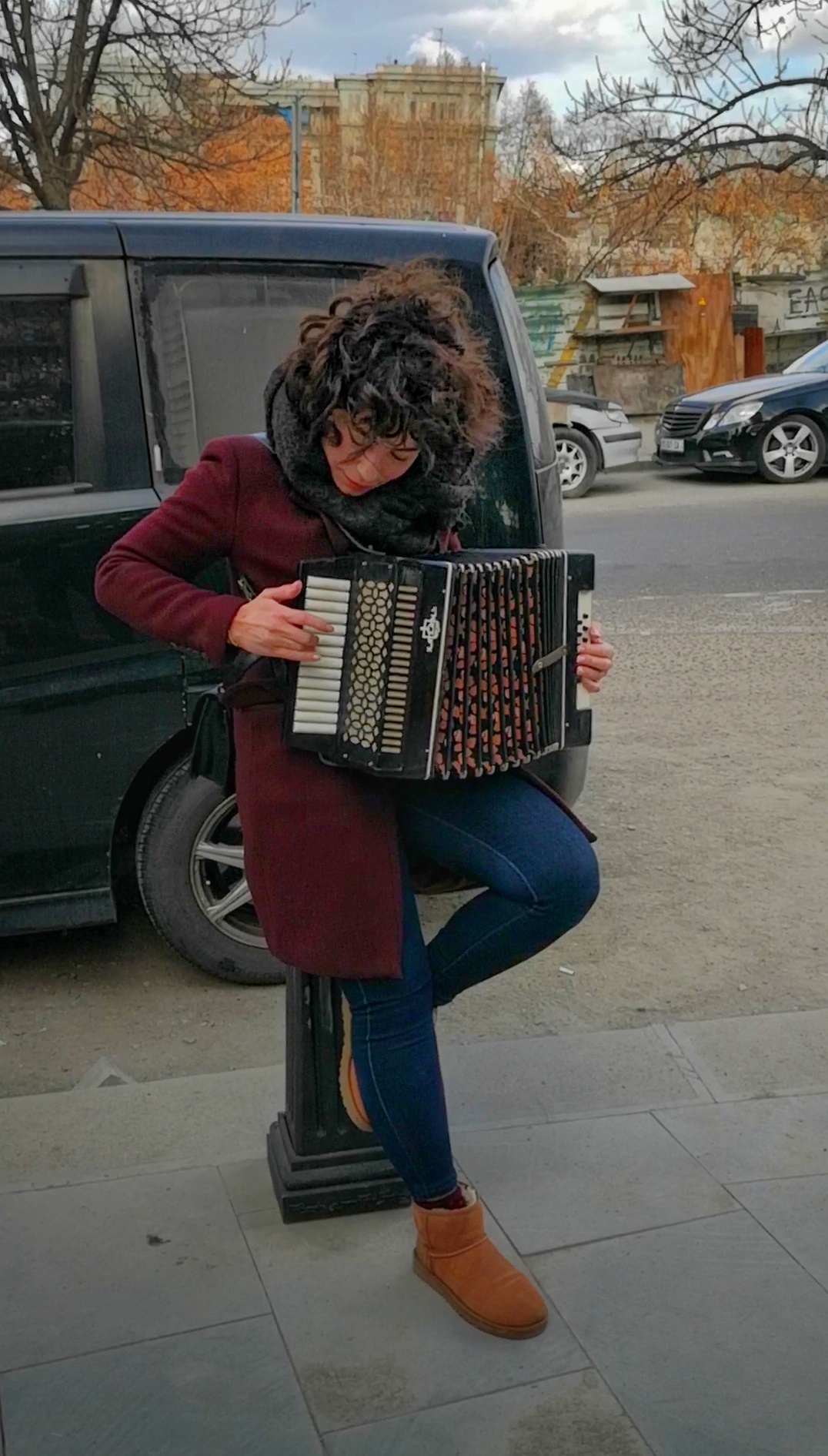
I buy something every time I go. So far: A garmon, 4 Yugoslavian-made crystal glasses, silver earrings and brooches, a Soviet cap and a Volgograd victory medal 🙂


SERGEI PARAJANOV STATUE
While walking around Old Tbilisi, you can see a statue of a flying man, Sergei Parajanov. This esteemed person is one of the greatest masters of traditional cinema and a person from another world. A lyrical, exotic, oriental style is generally felt in his films, and there are a lot of folkloric elements. He transferred the folk tales of the Caucasus, Moldova, and Ukraine to the big screen.


It has visually stunning cinematography. He includes very little dialogue in his films, which makes the audience envy rural life and nature. He is distant from civilization and universal cinema. It is useful to take into consideration the following words of the master, which summarize his understanding of cinema: “The best film is the film made for deaf and mute people. We talk too much; there are too many words. My intention is to find the pure beauty that goes beyond speech.“

Bonus: It is believed that if you caress the noses and feet of brass statues and make a wish, it will come true. That’s why the noses and feet of the statues are brighter than the other parts 🙂
MZIURI PARK

Mziuri Park, located in the Vake district, is one of the liveliest, most charming and most peaceful places of rest in Tbilisi. Famous Georgian writer Nodar Dumbadze started the construction of the park in 1982 because he wanted to create a big city for children in Tbilisi. At the entrance of the park, there are statues of famous characters that every Georgian loves and admires. In order to offer educational and entertaining activities to the public, the cafe inside Mziuri was rebuilt and made more social. It is worth noting that it is the only cafe that offers braille menus for the visually impaired 🙂
VAKE DISTRICS
It is known as a rich district. There are luxury shops, restaurants, and bars. There are beautiful parks, nineteenth-century architecture, luxury shops, restaurants, and bars. Vake Park: Opened in 1946, the park is one of the meeting points of local people, especially in nice weather. It is an ideal place for families with children, those who want to spread out on the grass, and those who love walking.
OPEN AIR MUSEUM OF ETHNOGRAPHY
An open-air museum exhibiting examples of folk architecture and handicrafts from various regions of the country. Founded on April 27, 1966, the museum is a historical village filled with buildings moved here from all subregions of Georgia. The museum covers an area of 52 hectares, with approximately 70 buildings and more than 8,000 items on display. The museum is divided into ten areas, each showing a different aspect of Georgian ethnology. Tbilisi is one of the places I liked very much during my trip 🙂


In the museum, traditional darbazi type and roofed stone houses from Eastern Georgia; houses with gabled roofs or wooden borders from western Georgia; watchtowers from the mountainous regions of Khevsureti, Pshavi, and Svaneti; millet granaries from Megrelian and Imeretian; Kakhetian wineries (marani); and Kartlian water mills are on display, as well as traditional household items such as knitted frames, clothing, carpets, ceramics and furniture.
There is also an early Christian “Sioni” basilica from Tianeti and a 6th–7th century family tomb dome with sarcophagus. The museum has also hosted the folk culture festival Art-Gene since 2004. The museum is closed on Mondays and is open to visitors between 10:00 and 18:00 on other days.
KUS TBA
You can rent pedal boats and swim in the lake, which got its name because of the abundance of turtles. There are buffets and restaurants around the lake with mountain and city views. People from Tbilisi used to come to this lake to relax. The cable car used to exit leaves from Vake Park 🙂

HOLY TRINITY (SAMABE) CATHEDRAL of TBILISI
Built between 1995 and 2004, it is the world’s third-tallest (101 m) Eastern Orthodox cathedral and one of the world’s largest religious buildings by total area. During your trip to Tbilisi, you can easily see Sameba Cathedral from many parts of the city.
Sameba is a synthesis of the traditional styles that dominated Georgian church architecture at various stages of history, with some Byzantine undertones. The cathedral, whose golden dome can be seen from almost any point in Tbilisi, is a complex consisting of a monastery, a school, a hotel, and nine chapels; five of them are underground.

It emerged as an idea to build a new cathedral in 1989 to celebrate the 1,500 years of autocephaly of the Georgian Orthodox Church and to commemorate the 2000th anniversary of the birth of Jesus. In May 1989, the Georgian Orthodox Patriarchate and Tbilisi authorities launched an international competition for the “Holy Trinity Cathedral” project. More than a hundred projects were submitted in the first part of the competition. In the end; the design of architect Archil Mindiashvili won.


Years of unrest in Georgia delayed this magnificent plan for 6 years, and its foundation was laid only on November 23, 1995. The construction of the church was declared a “symbol of Georgian national and spiritual revival” and was financed mostly by anonymous donations from businessmen and citizens. On November 23, 2004, on St. George’s Day, the cathedral is consecrated by the Catholic Patriarch of Georgia, Ilia II, and high-ranking representatives of other Orthodox Churches of the world. Other religious and political leaders in Georgia also attended the ceremony.
Bonus: Autocephaly (a Greek word for self-defining thing, from autos = self and kephale = head) refers to orthodox churches and old eastern churches in Orthodoxy that are governed by their own heads and have self-appointed archbishops/metropolitans. Most Orthodox churches are included in this group. Autocephalous churches are independent and autonomous. They are not under the command of another patriarch, metropolitan, archbishop, or synod of another country, and they determine their own heads.
AGMASHENEBELI STREET
This street, which runs parallel to the Kura River, is one of the busiest commercial centers of the city. There are many Turkish tradesmen on this street, so it is also known as Turkish street. Like Rustaveli, there are many options for shopping, eating, and drinking. The buildings on Agmashanebeli Street and the following Marjanishvili Street, which were renovated in a classical way, date back to the 18th and 19th centuries. It looks like it’s from the 19th century.Each building is artistically decorated and painted in different colors. There are lamp posts on both sides of the road that resemble old classical times, and they even designed the garbage bins specially 🙂
DOLLS/TOY MUSEUM
It is a must for your Tbilisi trip, but if you have time, you can consider it. The Doll Museum in Tbilisi was founded in 1937 by the famous children’s writer Tinatin Tumanishvili. At the end of the 20th century, the museum was robbed and did not operate for almost 16 years. It was reopened in 2008.
